
Counteract treatment discontinuations with targeted support
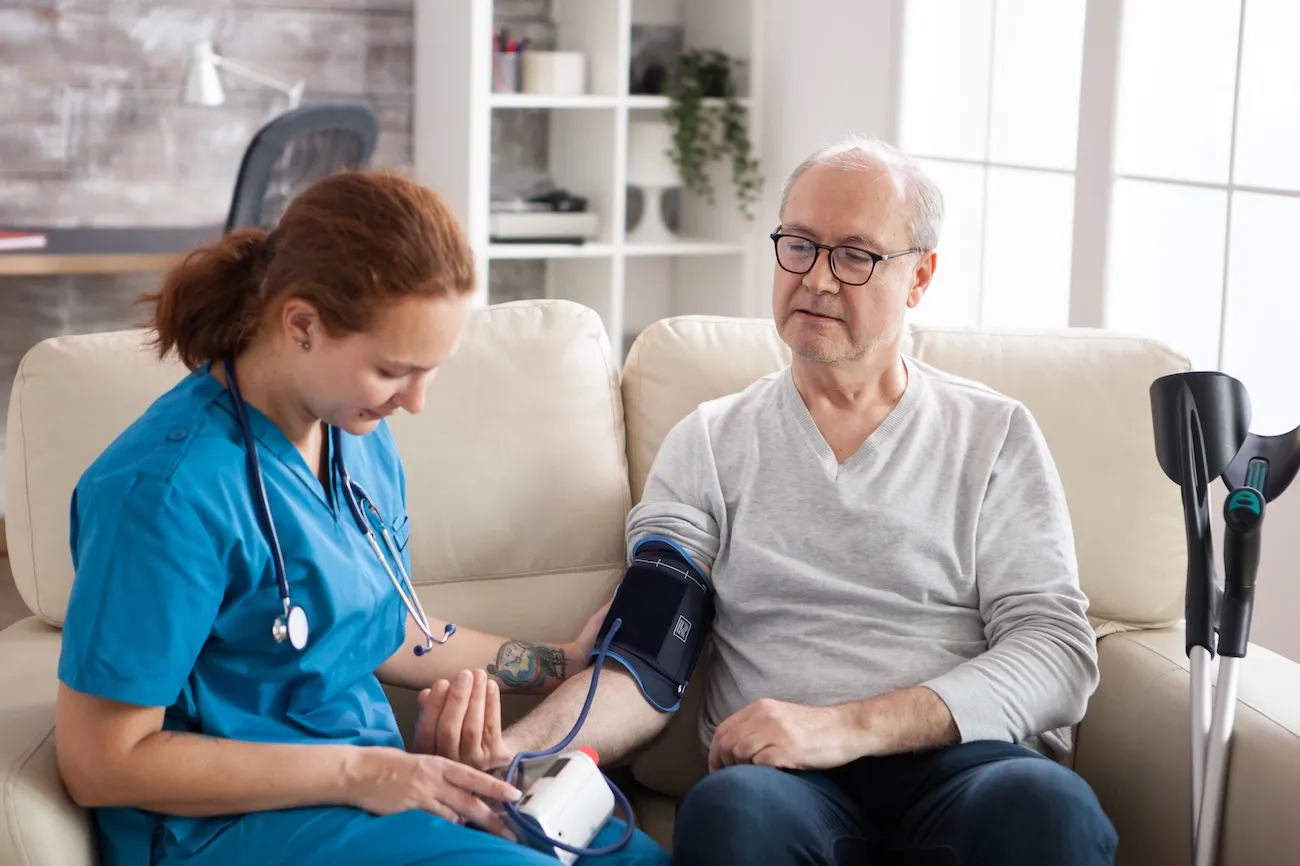
It often takes weeks from diagnosis to first use. After that, what is not on any package leaflet begins: Everyday life with therapy. Suddenly, the kitchen counter becomes an infusion place, the family calendar a medication plan, travel plans a question of adherence. Anyone who remains alone now drops out — sometimes silently, sometimes out of fear or overwhelmed. Our Approach: We provide support exactly where patients need it most — at home, with time, empathy and tangible expertise.
”Nurse services are in high demand — because they work. From injection training to infusion support to more complex services: Our goal is always the same — noticeably improve the patient's quality of life, ensure adherence, increase safety. ”
— Michael Weimann, Lead Patient Solutions
What our nurses actually do
On site We show step by step how therapy works safely in real life — from device handling to injection techniques and infusion processes to hygiene routines and typical sources of error. Objective is routine: Handles are safe, reproducible and documented.
In parallel, we keep side effects in focus: We identify and classify symptoms, de-escalate, if necessary, and work along clearly defined observation and escalation paths — including structured feedback to treating doctors. This creates safety and prevents treatment discontinuations.
Because life doesn't go by textbook integrating We do therapy in shift work, family and mobility: storage, cold chain, travel checklists, reminders — pragmatic and adapted to each individual patient.
recce is more than information: We explain that patients can act — comprehensible, attentive, relieving. Relatives are included without becoming “reluctant co-therapists.”
And Everything is understandable: Every measure, every note, every observation is documented in a structured way — auditable and with added value for all parties involved. Documentation thus becomes a joint learning curve between patient, practice and care.
”Our task is to replace complexity with proximity. We bring structure to unusual processes — respectfully and always with a view to patients' lives. ”
— Hannes Prüssner, Operations Manager
Why “home” is the most clinically relevant place
In the home setting, it is decided whether a therapy is sustainable. Is there space, light, peace? Who is really helping — and when? Which step fails in everyday life even though it was “in theory”? Our nurses see what questionnaires don't cover. you Translate regulation into practice — and recognize small signals that prevent major complications.
Particularly effective for:
- Rare & complex indications (high demand for information, fragile paths)
- Chronic diseases & geriatrics (prevention, self-employment, anti-isolation)
- Families with a high care load (Guidance, relief, reliable contacts)
Quality that can be tested
Quality is not just a buzzword for us, but foothold for people who rely on us. That is why we work SOP-led, document every step and clearly identify responsibilities — so that care is not only good, but comprehensible at any time.
Compliance is not an “extra”, but an operating system: free choice of pharmacy, GDPR-compliant consents, PV/QM-compliant reporting structures and transparent information channels are strictly adhered to and reflected in the process.
And because trust requires data measure We what counts: training recall, adherence KPI, response and intervention times, and patient-relevant outcomes — Quality that you not only feel, but prove Can.
What our clients report in 2025 (anonymized survey)
- satisfaction: 100% of the clients surveyed rate our nurse service positively
- Recommendation: 100% would recommend us.
- “worth money” & performance: 100% confirm the value of the service they have experienced; 100% experience commitment, solution orientation, rapid and effective processing of concerns.
- Early identification of risks: 100% see problems and risks preterm recognized.
- Digital development: Two thirds attest that we have distinctive perception for digital development — feedback that we actively translate into roadmaps.
Delegable — but not arbitrary
Services can — where professionally and legally required — in medical delegation take place: defined infusion doses, IV injections, monitoring of vital signs, structured monitoring of side effects. Decisive principle: Our nurses act within clear protocols, with documented escalation paths, in close coordination with doctors. surety for patients, doctors and clients.
Tandem instead of silos: proximity on the phone, local expertise
Care is teamwork. Where appropriate, we connect telephone support and On-site deployments: First clarify, structure, discuss — then visit, guide, strengthen. This tandem logic speeds up learning curves, reduces idle time and uses resources where they have the biggest effect: on humans.
What patients really feel
When our nurses start with patients, they schedule the course for the following months: Fear decreases, mistakes less frequently — trust grows. Uncertainty becomes routine, routine becomes stability. Therapy lasts when it is understood and experienced as feasible: We explain comprehensibly, show step by step and provide reliable support so that patients know what they do why It works and like they deal with hurdles. It remains dignity The standard: We give time, listen and allow real questions — where life takes place at home. In this way, patients retain their independence, shape their everyday lives in a self-determined manner with therapy and experience care as support, not as a burden.
Patient voice:
“Despite my complex illness, vacation was possible — and thanks to the perfectly organized local infusion, it was even carefree. Everything was smooth, competent and friendly. My energy tanks are full again — and hiking in the mountains is the best medicine for me.”
— K.H. from W.
What really relieves doctors and nurses
Delegable shares are reliably organized by us: Training, applications and standardized observations are carried out according to clear protocols, are fully documented and reported back to the treating doctors in a structured manner. This is how we recognize early warning signs timely — small problems remain minor, unplanned complications become rarer. This noticeably reduces the pressure on practices: more time for what only doctors can do — well-founded diagnostics, complex decisions and targeted treatment adjustments.
”We measure because we want to make an impact. For us, processes are means to an end: They protect, structure — and give people time together. ”
— Michael Weimann
A day that changes a lot — a real scene
First day of therapy, shaky hands, three pieces of paper, a question: “What if I do something wrong? “Our nurse sorts, explains, shows off, lets you do it. It shows the small mark on the device, the handle that prevents syringe breakage, the timer trick that gives peace of mind. As the infusion is running, someone breathes for the first time in days. It's not an aha moment. That is needs-based care.
Boundaries that protect
Nurses supersede no doctors. you reinforcing. They escalate when necessary; they endure when it helps; they say no when Safety over speed goes. Good care requires attitude — professionally, humanely, ethically.
”For us, profession means: Proximity with distance, empathy with clarity, commitment with limits. That is demanding — and that is exactly why it is important. ”
— Hannes Prüssner
Interview — Anton Luchner, Management Board Medperion Austria
Question 1: Where do you see the biggest lever nurses have in the home environment — clinically and humanly?
Luchner: The biggest lever lies in transitioning — from regulation to everyday life. Clinically, it's about safe use and early detection of warning signs; humanly, it's about Reducing anxiety and uncertainty as well as Ability to act. When patients know “I can do that,” uncertainty tilts into Self-Efficacy. This is exactly where the process changes — often quieter than any study can depict, but highly relevant.
Question 2: Which quality criteria are not negotiable?
Luchner: Processes, supervision, complete documentation, clear escalation paths. Compliance is not a footnote, but operating system: GDPR, pharmacovigilance, quality management — including ensuring free pharmacy choice. And: continuous qualification — skills become obsolete, attitude does not. We protect both.
Question 3: How can integration with doctors be achieved without creating friction?
Luchner: By clear roles, structured feedback, and dependability. We work with the ability to delegate — with precise logging. Doctors decide, we prepare, execute and reflect back. Not competition, but reinforcement.
Question 4: What does “success” mean — and how do you make it measurable?
Luchner: Success is when Therapy counts in life. Measurable in terms of adherence, training recall, time until safe self-administration, fewer unplanned doctor contacts and patient-relevant outcomes. And qualitatively with sentences such as:”Now I'm daring.”
In the end, it's about attitude
Our nurse service is not a “nice to have” service. He is a Commitment: We don't leave patients alone — not with injections, not with side effects, not with their questions. We work structured, auditable, compliant. And we believe that real care between two appointments emerges. If you strengthen what's in between, you strengthen the whole thing.
In short:
Nurses make care reliable — for patients, relatives and treatment providers. With time, expertise and respect. With structures that support. And with the aim Not only to prescribe health, but to make it possible in everyday life.
