

Younger doctors in particular have a high preference for digital elements. This applies to contacting us via email as well as to using messengers and social media. The RX Multichannel Monitor study examined specialist media usage behavior of dermatologists and oncologists. An overview of the most important findings, classified by Jörg Barnhusen from Brandpepper.
Contact preference:
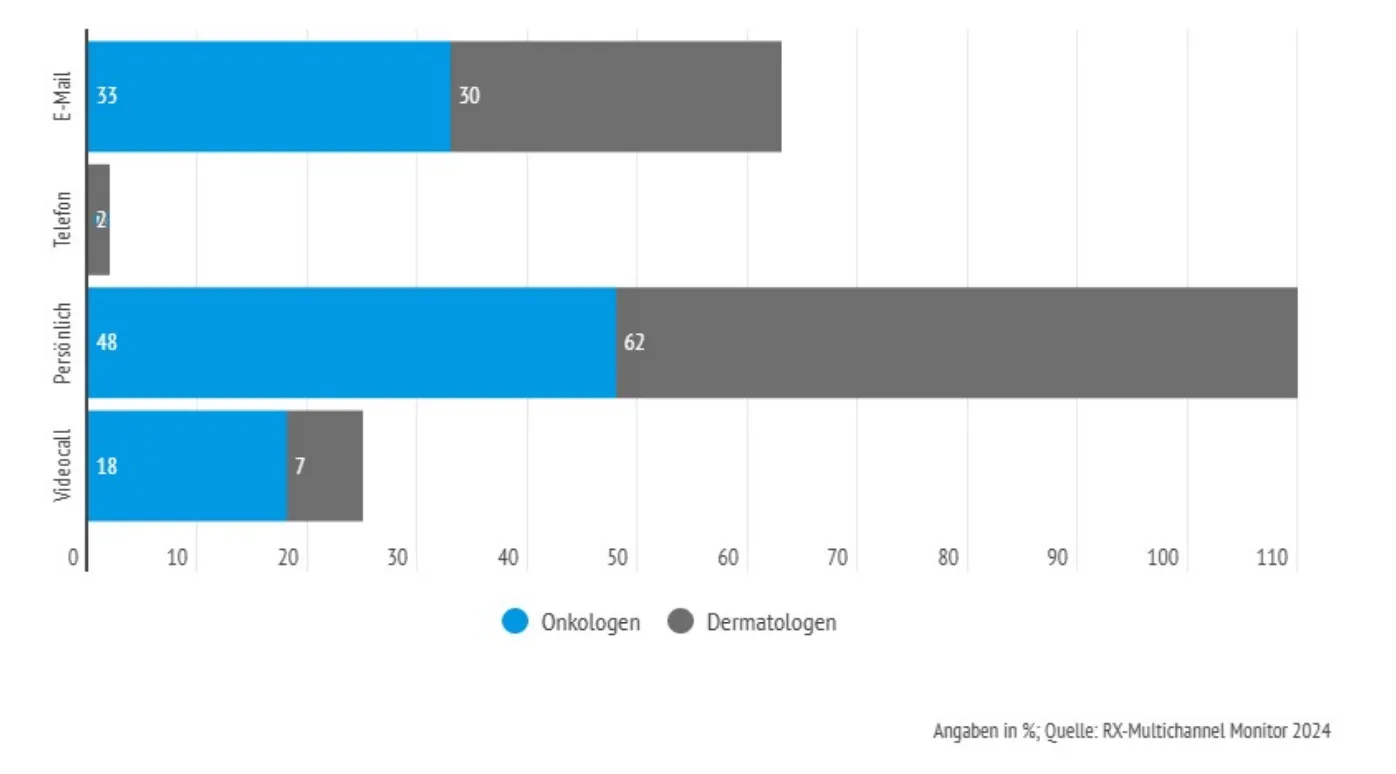
Younger people via email Dermatologists and oncologists appreciate the personal, professional exchange. 62% of dermatologists and 48% of oncologists would like direct face-to-face contact. The share rises to up to 70% if you add telephone and video calls. “Before the pandemic, we had a clear preference for the email channel. This has fundamentally changed as a result of doctors' experience during the pandemic. The need for personal contact to find out about medical or pharmaceutical issues is greater in 2024 than it was before the pandemic,” says Jörg Barnhusen, member of the management board of Brandpepper, an agency part of the Medperion Group.
However, this statement cannot be generalized, he admits, because the survey shows differences in contact preferences depending on professional experience: Younger doctors, with less than 10 years of professional experience, would prefer to receive specialist information by e-mail, while 67% prefer personal exchange among more experienced colleagues. “That's an important difference that you have to take into account when it comes to communication.
What contact preferences do doctors have?
What is the RX multichannel monitor?
The quantitative online study has been carried out annually since 2019 by The Lifesights Company and Medperion. For the current study (2024), 60 oncologists and 60 dermatologists were interviewed via questionnaire last year. The resident doctors provided information on their media and information behavior, the use of newsletters and digital services.
Relevant sources of information for dermatologists and oncologists
Websites of professional associations and publishers
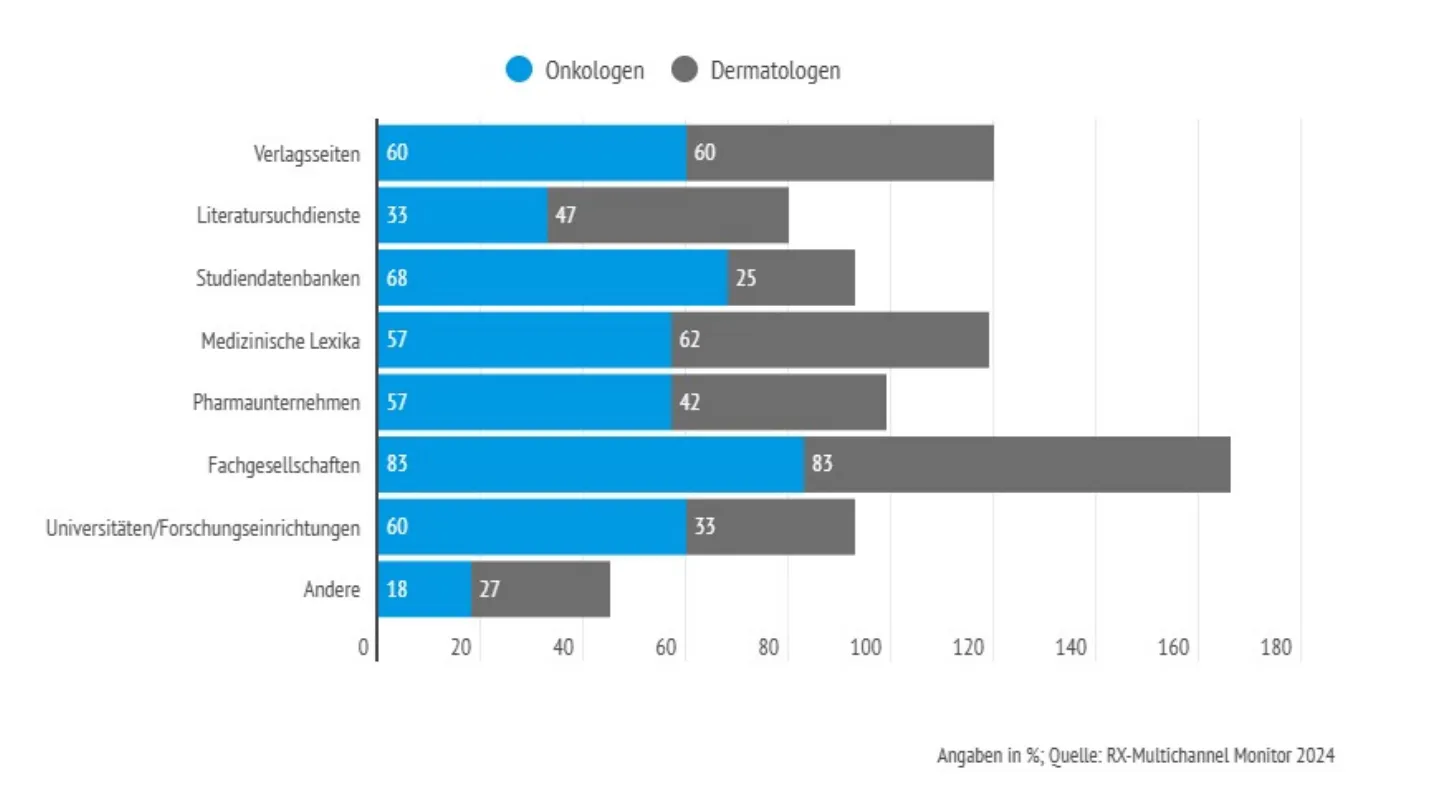
Dermatologists and oncologists use the Internet every day as a central source of information. They particularly frequently use the websites of professional associations for their professional research (83%). At 60%, publishing sites are also a central point of contact. Oncologists are also increasingly using study databases and the websites of universities and research institutions to obtain up-to-date, scientifically based findings.
Physicians particularly appreciate digital services with real added value on specialist websites. A media library that allows subsequent access to webinars and live streams is particularly in demand. Topic-specific forums are also gladly used for collegial exchange. On the other hand, traditional newsletters and push notifications are less popular - especially among dermatologists, their relevance has declined significantly compared to the previous year's survey.
Where do doctors get digital information?
Which pharmaceutical information is well received?
- NEWSLETTER: Doctors use the pharmaceutical industry's online newsletters. On average, oncologists subscribed to 8.5 newsletters and dermatologists to 4.4 newsletters.
- E-MAILS: Doctors sometimes receive twice as many emails from pharmaceutical representatives as they did a few years ago. Most receive between 11 and 20 emails per month (oncologists 47%, dermatologists 32%). Only around one in two people consider these emails to be very important or important.
- WEBSITES: The websites of pharmaceutical companies are a relevant source of specialist research for many doctors (oncologists 57%, dermatologists 42%).
Open for social media and messengers
75% of the oncologists surveyed use medical communities (Coliquio, Esanum, DocCheck), 47% are active on social networks such as Platform X. In particular, female doctors with less than ten years of professional experience rely on these forms of communication. It is interesting that female doctors in particular find out significantly differently, they have a high preference for medical social media, they follow digital opinion leaders and incorporate this information into their daily work,” explains Jörg Barnhusen.
Influencers and social media have also become an important source of information for patients in the healthcare sector — with noticeable effects on everyday medical practice. Around 35% of oncologists and 25% of dermatologists say that these topics are increasingly influencing their daily patient conversations. Younger doctors in particular have this experience.
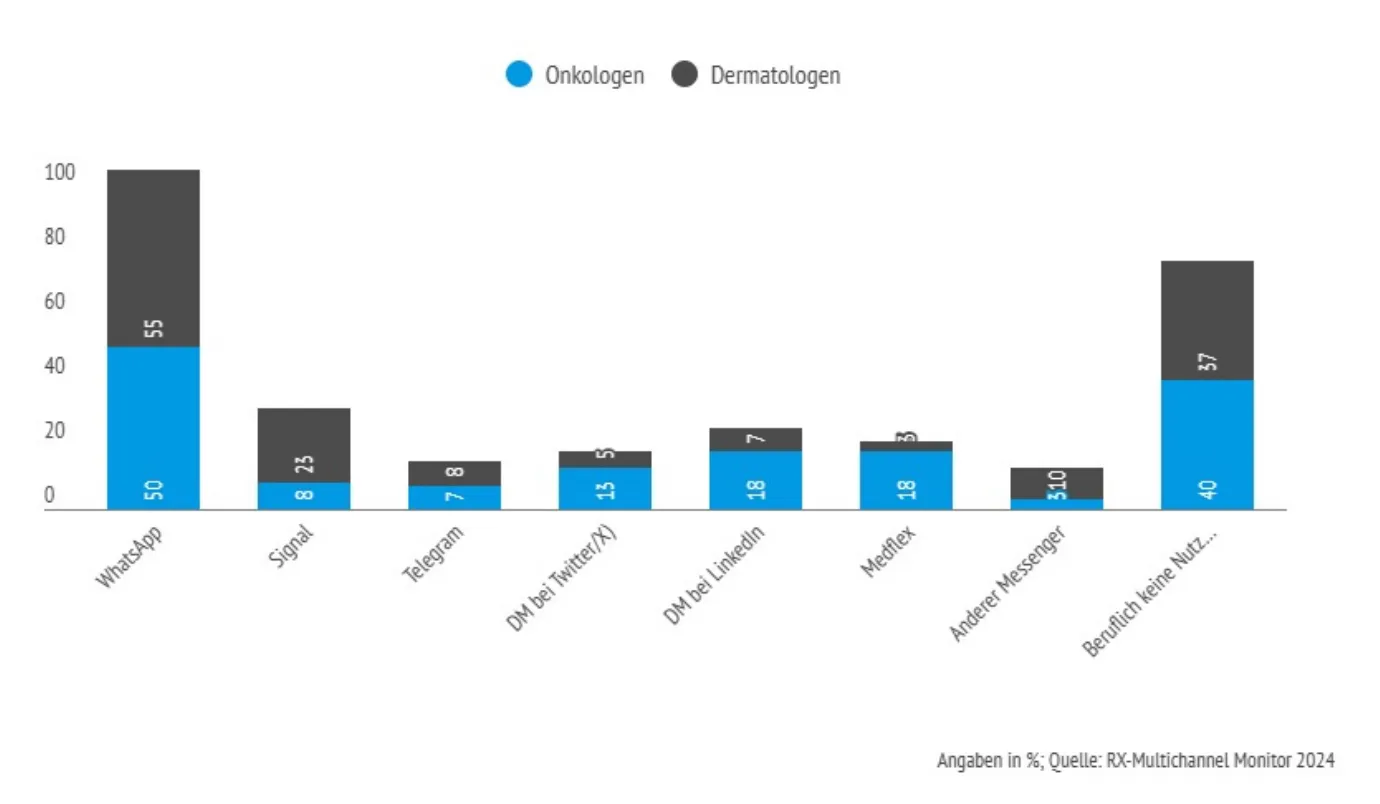
Around half now use WhatsApp for scientific communication. This is a significant increase compared to previous year's surveys. Alternative messengers such as Signal and Medflex are also gaining in importance. It is very clear that WhatsApp dominates in this area. That is a very clear position. Overall, oncologists have been using messenger services more and more frequently over the years,” observes Barnhusen. However, the use of such services remains controversial: Almost 40 percent continue to oppose the professional use of such services.
WhatsApp plays an important role
Young doctors collect CME points digitally
Certified digital training (eCME) has been very popular with dermatologists and oncologists for years. Webinars and virtual expert meetings follow closely behind as formats for professional exchange. Interesting: Almost all of the younger doctors rate eCME and webinars as very relevant.” Formats such as webinars, educational videos and podcasts are well received by those with less than 10 years of professional experience — particularly among female doctors.
However, face-to-face events have therefore not become unimportant: Doctors attend an average of 6.5 to 7.5 face-to-face events per year - only slightly more than digital training courses (5.4 to 7.0 times). As a result, interest in virtual formats remains high, while face-to-face events continue to play a central role.
%201.webp)